
When a bike geometry chart does not add up, its own numbers show which cell is wrong
A geometry chart's cells are not independent. Front centre and wheelbase follow from stack, reach, head angle, fork offset, bottom-bracket drop and chainstay, so a minute of arithmetic shows which cell to question before a calculator turns a misprint into precise advice. On LightCarbon's LCR018-D table it reproduces three sizes to 0.1 mm and isolates one cell that is 10 mm out.

Recompute the cells that depend on the others
Measured horizontally, the front axle sits reach + (stack − BB drop) ÷ tan(head angle) + fork offset ÷ sin(head angle) ahead of the bottom bracket. Most charts print front centre as the straight line from the bottom bracket to the front axle, which is √(horizontal² + BB drop²). Wheelbase is the horizontal front centre plus the rear centre, √(chainstay² − BB drop²), because chainstay is a straight-line length too.
Take LightCarbon's LCR018-D in size 540: 383 + (569 − 76) ÷ tan 72° + 51 ÷ sin 72° = 383 + 160.2 + 53.6 = 596.8 mm, or 601.6 mm on the diagonal, which is the printed front centre. Adding √(415² − 76²) = 408.0 mm gives a 1004.8 mm wheelbase, also as printed. Cells that agree within a millimetre describe one frame. A bigger gap means one cell is wrong, uses the other convention (diagonal or horizontal) or comes from another revision. Do not average conflicting values: the result might describe neither frame.
Four LCR018-D cells to question before you calculate
The LightCarbon LCR018-D record keeps these conflicts with their sources. The first is the standover reference: LightCarbon’s 2026–2027 catalog (V5, checked October 11, 2026) labels it with a 700×38C basis, while the product table observed October 3, 2026 labels it 700C×32C, as it still did on October 22, 2026. Arithmetic cannot settle a tyre basis, and standover figures on different bases are not comparable.
The product table observed on October 3, 2026 prints the size-580 front centre as 606.4 mm. Its own stack, reach, head angle, fork offset and BB drop give 616.4 mm, the figure the V5 catalog prints, and its own 1020.3 mm wheelbase fits 616.4 but not 606.4, which would give 1010.2 mm. The 606.4 is very probably a misprint; LightCarbon has not confirmed which value is correct.
The same product table, observed October 3 and again October 22, 2026, prints the size-560 wheelbase as “1006.3 +mm”. The digits fit: the column’s other cells give 598.3 + 408.0 = 1006.3 mm. Only the plus sign is unexplained, so ask what it means before treating the cell as settled.
The two smallest sizes do not add up either. Their printed front centre and wheelbase agree with each other but are 3.7 to 3.8 mm longer than stack, reach, head angle and fork offset give. The table cannot show which cell is out, so query the 470 and 500 before using their reach or front centre in a fit or toe-overlap calculation.
| Size | Front centre, printed (mm) | Front centre from the other cells (mm) | Wheelbase, printed (mm) | Wheelbase from the other cells (mm) |
|---|---|---|---|---|
| 470 | 580.9 | 577.2 | 983.3 | 979.5 |
| 500 | 589.5 | 585.8 | 992 | 988.2 |
| 520 | 589.8 | 589.8 | 992.2 | 992.2 |
| 540 | 601.6 | 601.6 | 1004.8 | 1004.8 |
| 560 | 603.1 | 603.1 | 1006.3 + | 1006.3 |
| 580 | 606.4 | 616.4 | 1020.3 | 1020.3 |
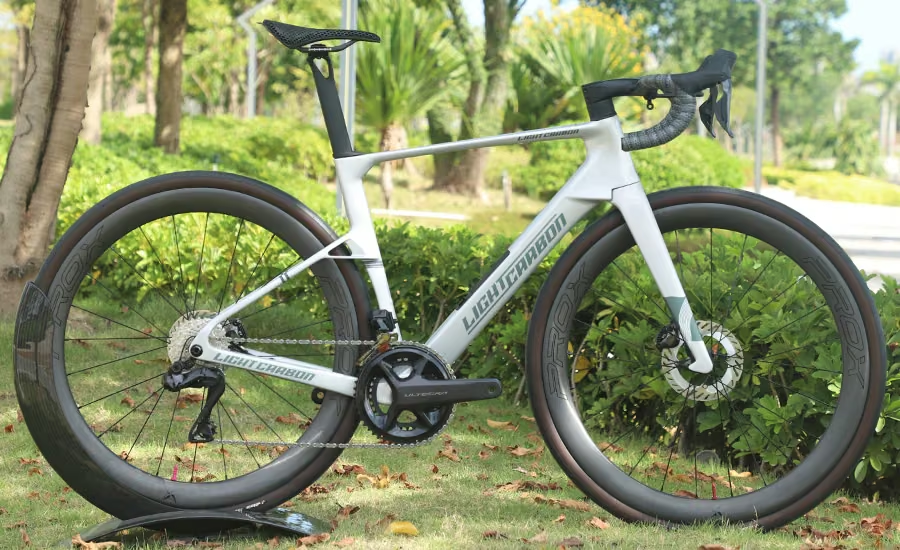

Ask the question the arithmetic points to
Send the highlighted table with one precise question: “Your LCR018-D table prints the size-580 front centre as 606.4 mm, but its stack, reach, head angle, fork offset and wheelbase give 616.4 mm, as in your V5 catalog. Which value applies to the frames you ship now, and what does the plus sign after the size-560 wheelbase mean?” A reply that the frame is “comfortable” does not resolve a numerical mismatch.
Until the answer is usable, leave the affected calculation open: front centre decides toe overlap, and wheelbase enters handling comparisons. To put two makers’ charts side by side, use comparing two geometry charts; the standover and bag-space guide separates that dimension from the space a packed bike actually needs.
Sources
Source review began . Research methodology.